 Resources
 Campus Life
 Just for you


 My Canyons
  Canvas
News Release
FOR IMMEDIATE RELEASE
NR-09-09-26-AST
September 9, 2026
AST Celebrates Decade of NASA-Affiliated Projects
For the past 10 years, the sky has been the limit for the College of the Canyons Aerospace and Science Team (AST), which has provided students with hands-on research opportunities through NASA student spaceflight programs, including the High Altitude Student Platform (HASP), RockSat-X and RockOn!
As the only community college to successfully be selected to participate in NASA's HASP program for 10 consecutive years, COC continues to provide students with unique opportunities to design, build and launch scientific experiments into the upper atmosphere.
To date, COC students have completed 10 HASP missions, seven RockSat-X missions and five RockOn! missions.
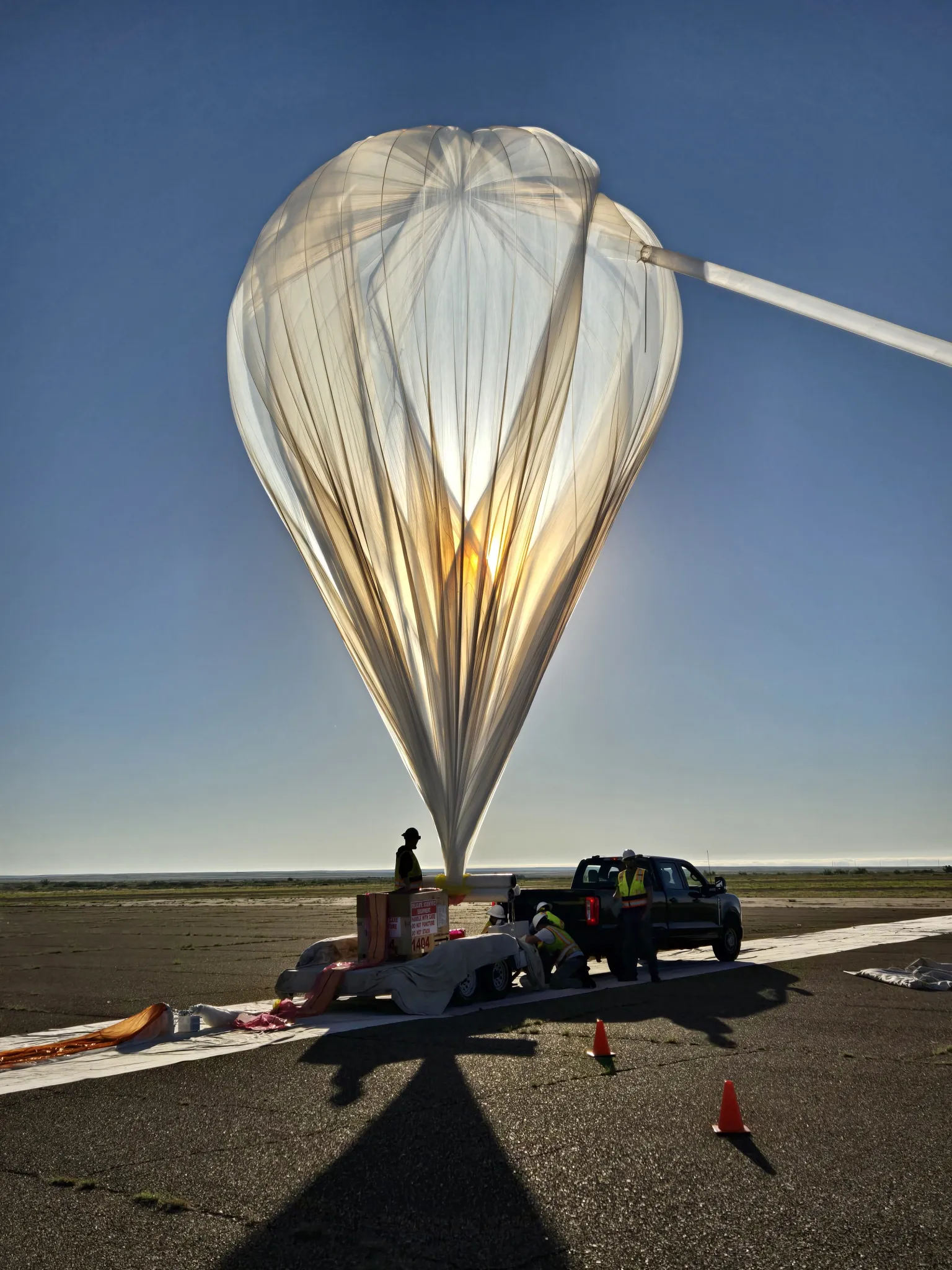
Most recently, a team of AST students successfully launched a research experiment aboard NASA's HASP scientific balloon at Fort Sumner, New Mexico, on Sept. 2. The project featured an array of Geiger counters encased in different shielding materials, and two left open to space as controls, with the goal of testing how well different materials may shield astronauts in minimal atmosphere science that may protect astronauts as we colonize the Moon and Mars.
"Reaching a decade of NASA-affiliated research projects is an incredible milestone for the Aerospace and Science Team," said Teresa Ciardi, AST advisor and a physical science and astronomy instructor at the college. "What makes this achievement especially meaningful is that it reflects years of hard work by hundreds of students who have dedicated themselves to scientific discovery and innovation. Their success in these programs continues to open doors to scholarships, internships and careers throughout the aerospace industry."
AST missions require student-led teams to propose, design, fabricate and test scientific payloads for launch from sites across the country. Students prepare these experiments to fly aboard NASA flight vehicles, collecting valuable scientific data while gaining practical experience in aerospace engineering and research. AST students compete with university teams to have their experiments flown on NASA vehicles.
NASA's HASP program provides educational institutions and STEM students the opportunity to design, fabricate and launch scientific payloads aboard a high-altitude balloon that remains in the upper stratosphere for 12 to 16 hours. Managed by the Louisiana Space Grant Consortium (LaSPACE), the program works in partnership with NASA and other space-focused organizations to provide students with real-world aerospace experience.
This year, the COC team hosted a JPL proprietary photonics payload and a sensor suite to monitor space conditions during flight that was developed by members of the Local Group Astronomy Club of Santa Clarita Valley, demonstrating the team’s ability to collaborate with other entities involved in space research.
In addition to its HASP mission, AST students also participated in NASA's RockSat-X and RockOn! programs during the summer of 2026.
On June 24, 2026, the team launched an experiment aboard NASA's RockSat-X sounding rocket at Wallops Flight Facility in Virginia. The student-designed payload, ATOMALiS, collected thermal and imaging data to evaluate the potential use of Light Detection and Ranging (LiDAR) technology in future aerospace applications. Temperature data was obtained for the duration of the space flight from sensors placed outside and inside the rocket. The project also incorporated machine learning analysis to assess how effectively onboard systems can identify and map objects during flight.
NASA RockSat-X, managed by NASA Wallops, allows students to design, fabricate and launch original scientific experiments aboard a two-stage NASA sounding rocket. The program challenges participants to develop payloads capable of withstanding the intense conditions of launch and spaceflight, including 30 g's of force.
Included on the RockSat-X sounding rocket was a RockOn experiment that three COC students had assembled and tested. RockOn students participated in a one-week conference workshop during which they built, tested and launched a sounding rocket experiment into space.
NASA RockOn! is a seven-day hands-on workshop at NASA Wallops Flight Facility designed for collegiate students and faculty with little or no prior aerospace experience. Participants learn how to assemble and integrate a scientific payload before launching it aboard a sounding rocket on the program's final day.
"The Aerospace and Science Team provides students with opportunities that extend far beyond the classroom," said Greg Poteat, AST advisor and manufacturing technology adjunct instructor at the college. "Through these NASA programs, students gain hands-on experience in research, engineering and problem-solving while working on projects that have real scientific value. Their accomplishments continue to demonstrate the exceptional talent and dedication of our students."
Since the college's first NASA HASP mission in 2016, participating AST students have earned 201 scholarships or internships, including two full-ride awards to four-year universities, with internships at organizations such as NASA Jet Propulsion Laboratory (JPL), Caltech, TE Connectivity, Schweitzer Engineering Laboratories and NASA Goddard Space Flight Center.
AST students have also secured 14 full-time positions with leading organizations including Northrop Grumman, Tesla, Blue Origin, the U.S. Environmental Protection Agency (EPA), SpaceX, Millennium Space Systems, Amgen, XP Power, Lockheed Martin and Cicoil Corporation.
For more information about the Aerospace & Sciences Team at College of the Canyons, please click here.