 Resources
 Campus Life
 Just for you


 My Canyons
  Canvas
How It Started and Where its Going!
How it Started
The MESA Skills Lab started as an idea from Prof. Jim Wolf and College Ahmed Miloud. Them both and other professors around the college campus began to brainstorm ideas to create labs that will assist students in building skills to better their skills. They started designed a PCB for Professor Wolf's biology students to create and use a spectrophotometer. These students were part of the first group to ever start building the projects, however a problem just started. They lacked the skills to build a project so complicated like the Spectrophotometer that it did not succeed. Plans began to teach the skills required to build a unit successfully in 2019 but never got written out.
Covid
One of the many problems that arose during the Covid Pandemic, was the lack of Lab instruction for non lecture based classes. Prof. Jim Wolf, Amy Foote, and Madison Spero created a kit filled with biology and chemistry related instruments that will allow students to come into MESA, pick up a box, take it home, and join every week for a two hour instruction of how to use the equipment and what their applications would be.
Starting Engineering MSL
In February 2022, Arnold Cossio came in with interest in the biology/chemistry kits, and brought up the idea to create something similar with Engineering/ Computer science/ Physics. The first labs written were the Multimeter, Soldering and 3D printing/CAD Skills Lab. With the help of Dan De Loyola, and Derek Peraza, Arnold and Team were able to successfully teach the first group of Engineering in Fall 2022. The following year, the spectrophotometer Lab was written and taught successfully, allowing any student to learn the skills required and operate a spectrophotometer successfully and use it for data collection. Summer 2023, Arnold came up with the idea to create a new lab that would incorporate all the skills learned, and make a creative aspect not just following instructions. The first prototype of the physics cart was created and its lab began to be written the remaining of the year. It allowed students to incorporate their imagination to create any design and make it into a 3d printable design. The first group that build a physics cart was June 2023 with the help of Shawn Orleans
leading the first group of students through the process.. Revisions were followed by the throughout the upcoming years. Serj Kasparian and Arnold Cossio throughout the semester followed up with students regarding the physics cart lab to gather feedback and improve the first set of carts. This method to improve labs moving forward was applied to all future and existing written labs.
Starting CS MSL Projects
Ed Taguba and Tawshia Chowdhury helped create a HTML/CSS/JavaScript that showed any student the possibilities of web development. Each student was able to learn these languages and see how they are incorporated into a project they can customize and see what each line of code create. Alyssa Calleros, along with Joshua Rashtian created a video game that demonstrated the application of c# along with a unity engine. This later turned into a lab with assets for students to make and design.
Arduino Labs
In 2023 Vatche Patrikyan and Thomas Auerbach-Dinculescu began working on a lab dedicated to teaching Arduino and it was until 2024 when the first group was shown and the lab was implemented. This lab was created to demonstrate the potential for what computer programming can achieve at a smaller scale using a microcontroller. This lab and its applications were used later in 2025 to create the RC cart using a Raspberry Pi that was programmed in C++.
Safety Lab
Oswaldo Gavidia assisted Arnold in creating the first MESA Skills Labs Safety Protocol along with Do's and Don'ts for each lab and accident. The idea for these procedures came from Californias very own OSHA requirements for research labs and industry standards implemented in companies like Lockheed and Google. all the safety protocols were used to create slides for training staff, and students, along with a quiz at the end where each student is able to get signed off to demonstrate proficiency in safety. By 2024, all students who have and will participate in the Skills Labs will have a signature on file demonstrating they were trained based on the safety requirements OSHA has implemented California wide. It was Until 2025, where Steven Baker and Alonso Muñoz created a file that contained all content to successfully train a student in all safety related concerns for MSL.
RC Cart Lab and Java Lab
Spring 2026 brought a new version of the Physics Cart thanks to Richard Elm, where a fully controlled Car was created using a raspberry pi, Arduino code, and motor driver. the first group that successfully build the first batch of the RC cart was Spring 2026.
During the same semester Sanchita Modi Created and taught a Java Based Tic-Tac-Toe lab for students to learn without taking a class. This was the first lab that was finished within a semester from start of development to teaching. The same approach to creating labs proved successful with three revisions and the final revision after the 3rd one, be the one that is taught to students. The success of this lab demonstrated that the lap protocols for writing a new lab was successful and perfected to meet skills labs standards.
Future Projects
In 2023, David Shaker began working on a Slayer Exciter, which is a solid state Tesla coil that proved to be successful with a couple components that were shared with the Arduino Lab. This project went onwards to begin to be replicated, however it was not successful. Plans are still made to get to the project back and running. Ideally a Tesla coil would be permanently stored within the MESA center to entertain and inspire students to what the possibilities are of AC current and induction coils.
In 2024 Oscar Luevano, Marcus Grijalva and Noy Hakobyan were begging the stages of finding more difficult challenges to using the Arduino kits, by creating a audio visualizer using a program on the computer reflecting on the sound waves and displaying these different frequencies. This project also was successful but was not able to be replicated, and so a different project involving servo-motors to create a prosthetic arm began being planned however it was never assembled.
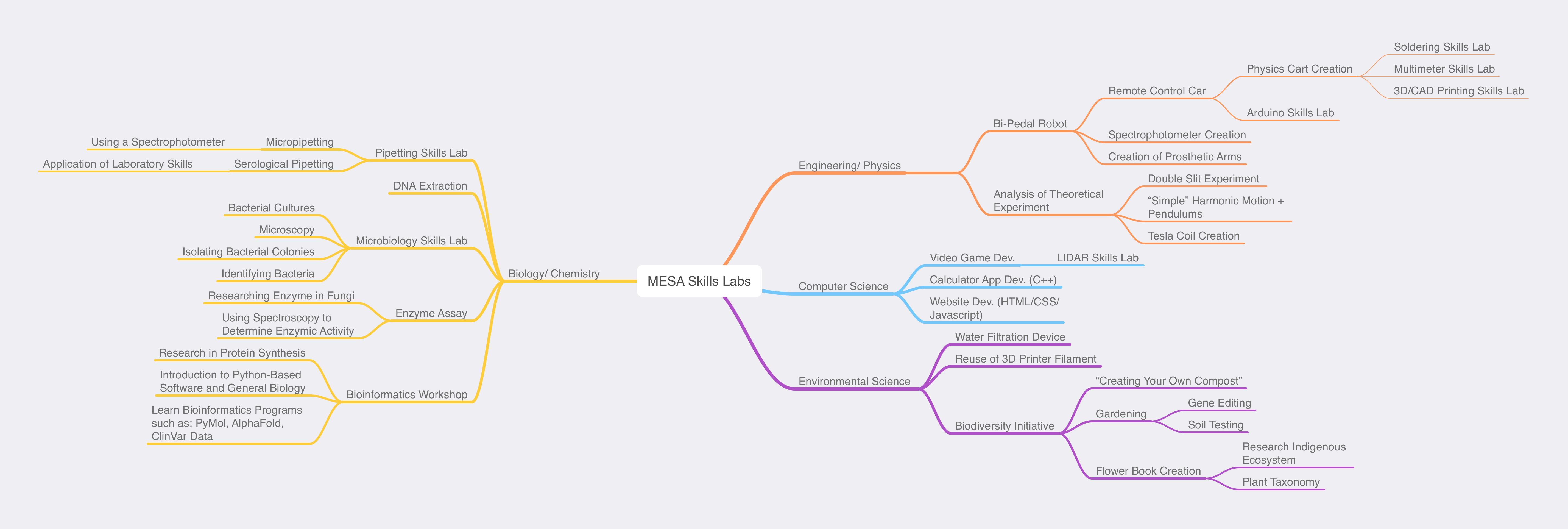
The tree map represents a collection of labs, some of which have already been developed and others that are planned for future creation to support student learning. These labs are designed to spark students’ curiosity and encourage them to explore their chosen majors more deeply. Each branch of the tree map corresponds to a different field of study. For example, engineering is closely connected with physics, while computer science and environmental science are distinct disciplines and therefore have separate branches. Some labs shown are fully developed and intended for instruction, while others are still in the planning stage, serving as ideas that may be expanded into future learning opportunities. As MSL develops, so will this tree map.