 Resources
 Campus Life
 Just for you


 My Canyons
  Canvas
Scholarly Presentation Committee
COMMITTEE PURPOSE
The Scholarly Presentation Committee is a sub-committee of the Academic Senate. The primary role of the Committee is to serve as a forum for faculty to showcase scholarly works and research in their fields of interest. The Scholarly Presentation is designed to be shared with the campus and broader community through annual presentations. The presentations will be 1 hour in length and will take place in Fall of each academic year at the Santa Clarita Performing Arts Center.
COMMITTEE DUTIES AND FUNCTIONS
The duties and functions of the Scholarly Presentation Committee are as follows:
- Promote, celebrate and showcase the talent and expertise of our faculty in each one’s respective discipline.
- Participate in selection of scholarly presenters for upcoming events.
- Create space for presenters to maintain integrity of their project, respecting the expertise of the presenter. Give feedback and support for draft and working presentations.
- Foster collaboration between Scholarly Presentation Committee and other campus-wide efforts. Assist with promoting presentations
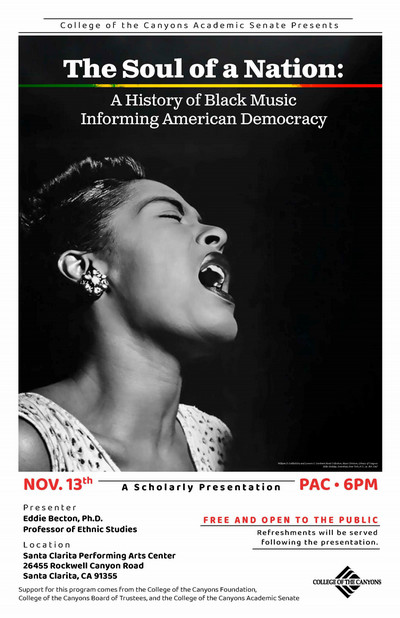
The Soul of a Nation: A History of Black Music Informing American Democracy Scholarly Presentation
Presented on Thursday, Nov. 13, 2025 at 6pm at the Performing Arts Center by Professor Eddie Becton.
Presenter Biography:
For more information visit the News Release!
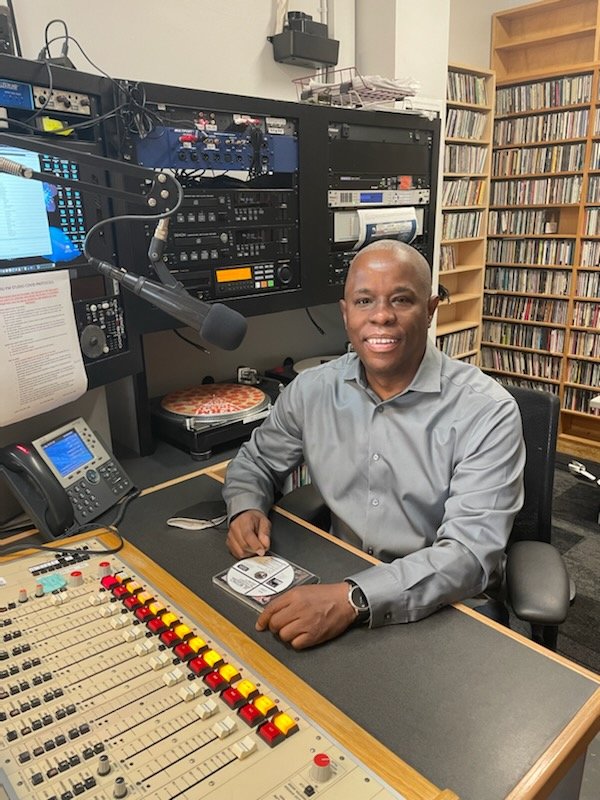
Behind Bars: Forfeiting Our Children
Presented on Thursday, Nov. 21, 2024 at 6pm at the Performing Arts Center by Professors Katie Coleman and Mehgen Andrade.
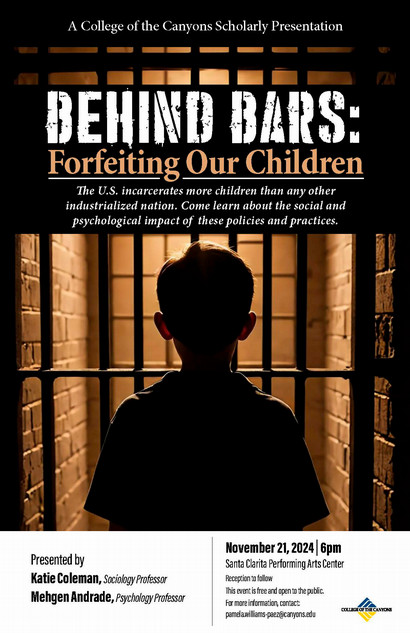
Professor Katie Coleman and Meghen Andrade shared their research on the social and psychological effects of incarcerating children. In the context of mass incarceration, the United States comprises five percent of the total global population and at the same time incarcerates 25 percent of the global population. “The United States has more children in its prisons than any other industrialized nation,” said Pamela Williams-Páez, chair of the college’s scholarly presentation committee. “The presenters will examine the social and psychological effects of these policies and practices, providing alternatives and humane solutions to the problem.”
For more information about the scholarly presentation, please contact pamela.williams-paez@canyons.edu.
Presenter Biographies:
Katie Coleman
Katie Coleman is currently serving as College of the Canyons chair of the sociology and ethnic studies departments and as chair of the equity-minded practitioners workgroup. She is a critical sociologist specializing in the areas of gender, sexuality, deviance, crime and social control. A COC alumna, Coleman received her master of arts degree in sociology from California State University, Northridge and a bachelor of arts degree in sociology from University of California, Santa Barbara. Her sociological research includes published papers on topics including the re-humanization of sexuality, the American prison system and the relationship between academia and intelligence agencies. Coleman began teaching at COC in the fall of 2008, covering courses in deviance, criminology, critical thinking, gender studies, sexuality, social problems, statistics and death and dying.
Mehgen Andrade
Mehgen Andrade has been teaching psychology at College of the Canyons over 15 years. She is the lead faculty member for cognitive psychology—her personal and professional area of expertise—covering topics of memory, decision-making, reasoning and neurocognitive development. The focused area of her graduate research was eyewitness memory. Andrade’s passion for academia extends beyond teaching, as she earned a juris doctor degree from Glendale University College of Law in 2021 and subsequently passed the California Bar Exam in 2022. This is in addition to her early academic pursuits in the area of cognitive psychology at the University of Nebraska, Lincoln for a doctorate in psychology, a master of arts degree in psychology in general psychology at California State University, Sacramento, and a bachelor of arts degree in Psychology from Mills College.
Spring 2022
Primate Conservation and Clean Water Programs in Central America and Africa
Presented in Spring 2022 at 6pm at the Performing Arts Center by Professor Sarah Etheridge
Dr. Sarah Etheridge gave updates on the last 10 years of her research in primate conservation and clean water programs in central America and Africa. You can view the 2012 presentation below. Dr Etheridge teaches in Anthropology and gave her Scholarly Presentation on primate conservation in 2012. She became Chair of Scholarly Presentation in 2018. Her research interests are primates, genetics, epidemiology and Egyptology.
Fall 2022
Flying Above the Dinosaurs: Uncovering the Mystery of Giant Pterosaurs
Presented on Thursday, Nov. 30, 2022 at 6pm at the Performing Arts Center by Professors Dr. Michael Habib
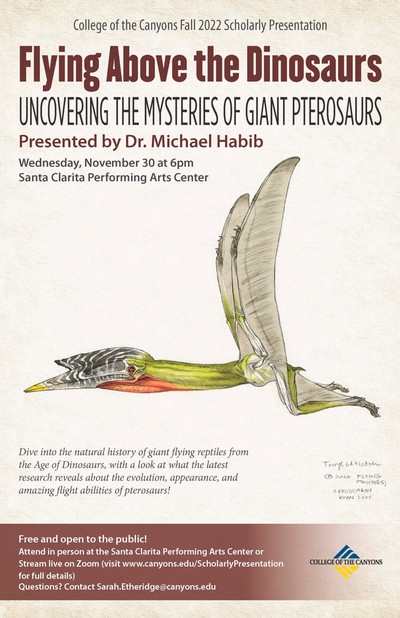
Dr Michael Habib: Dr. Michael Habib is an Adjunct Associate Professor of Medicine at the University of California Los Angeles, a Research Associate in the Natural History Museum of Los Angeles County, an Adjunct Professor of Biology at College of the Canyons, and a freelance writer/consultant. He is a paleontologist exploring the relationships between animal structure and motion, using a combination of anatomy, art, and engineering. Dr. Habib has authored numerous scientific papers, appeared in a diverse array of television specials, worked as a scientific editor for National Geographic Magazine, writes for Scientific American Magazine, and has applied science to creature design on over 20 projects for leading studios, including BBC, CBC, National Geographic, Creative Differences, YouTube Originals, Amblin Entertainment, and Apple TV+.
Spring 2021
Galapagos: A Personal Journey on the Footsteps of Darwin
Presented on Thursday, April 15, 2021 at 4pm at the Performing Arts Center by Professors Dr. Miriam Golbert
Dr. Miriam Golbert revisited her 2015 presentation “Galapagos: A Personal Journey on the Footsteps of Darwin,” which touched on the region’s unique geological formations, Charles Darwin’s time spent on the islands, as well as his various discoveries and scientific theories.
Dr. Golbert shared, “After my scholarly presentation on November 2015, many events have happened on the islands, good and bad." Dr. Golbert has also visited the Galapagos Islands four times. “I would like to provide an update on the conservation and restoration efforts, such as the reintroduction of giant tortoises to Santa Fe Island, the tortoise breeding programs, and the marine invasive species that have been detected.”
Golbert will also discuss the reintroduction of land iguanas on Santiago Island and the fact that 42 bird species are currently at risk of extinction.
Spring 2019
Bitchery and the Politics of Fashion
Presented on Thursday, March 28, 2019 at 4pm at the Performing Arts Center by Professors Ruth Rassool and Deems Marrione
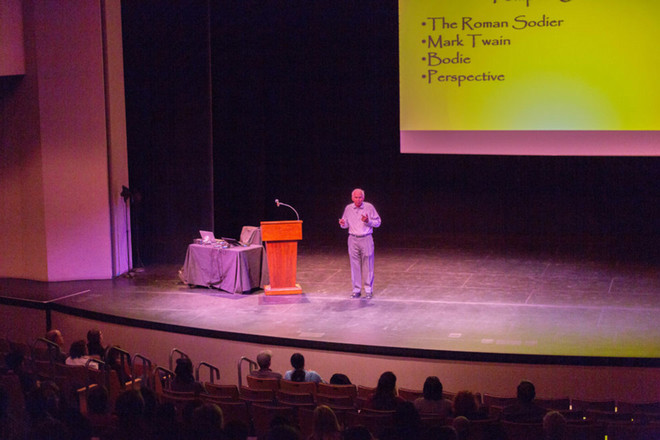
With the use of photos and video clips, the presentation revealed the intersection between fashion and politics as it relates to Foucault, Lacan and Baudrillard theory.
Rassool and Morrione’s interest in fashion led them to create “The Bitch Project,” which is a social media salon where the overt and covert political messages sent down the runway by fashion designers are analyzed and discussed. Notoriously negative in connotation, the word “bitch” has been reclaimed by the presenters for the sake of academic critique to identify cosmopolitanism in politics, fashion and pop culture. Presenters stated that “It is not a way to get attention — it is to present analysis in a way that is sardonic and biting". “As a noun, it suggests that a person holds to a set of standards and conveys a commitment to taste.”
Fall 2018
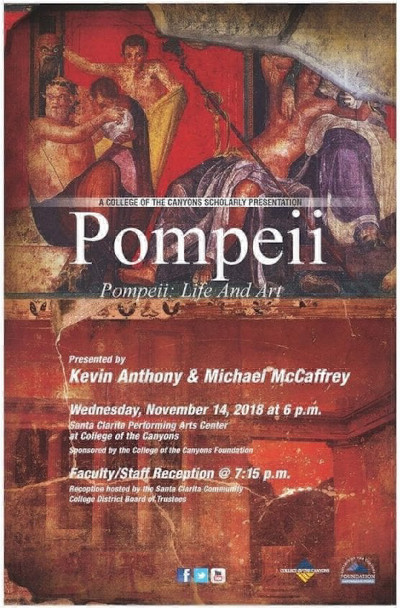
Pompeii" Life and Art' Sheds Light on Roman City
Presented on Wednesday, Nov. 14 at 6pm at the Performing Arts Center by Professor Kevin Anthony & Michael McCaffrey
With the use of photos and maps, McCaffrey and Anthony will shed some light on what life was like in the Roman city before the infamous eruption of Mount Vesuvius buried it under ash in 79 A.D.
To view a recording of this event visit: https://www.youtube.com/watch?v=xtFOFfoP9RM
Presenters Biography:
Michael McCaffrey
Michael McCaffrey, an art and art history professor at the college, will trace the origins of the visual narrative back to Pompeii through a detailed analysis of Roman style wall paintings, such as frescoes and friezes. Originally from Glasgow, Scotland, McCaffrey completed his undergraduate studies at the Glasgow School of Art in Scotland and earned a Masters in Fine Art degree from the University of Illinois after emigrating to the USA in 1991.
Kevin Anthony
Kevin Anthony, chair of the college’s hotel and restaurant management program, will take viewers on a virtual tour of Pompeii to better understand the way of life of its residents. As a student at the University of Loyola Chicago, Rome Center of Liberal Arts, he spent a year visiting Italy’s major museums and visited Pompeii three times. As a faculty member, he has led four study abroad trips to Rome, Italy and has been able to take students on field trips to Pompeii.
Spring 2017
Tataviam: People Who Face the Sun
Presented on Thursday, March 30, 2017 at 6pm at the Performing Arts Center by Professor Lori Solis
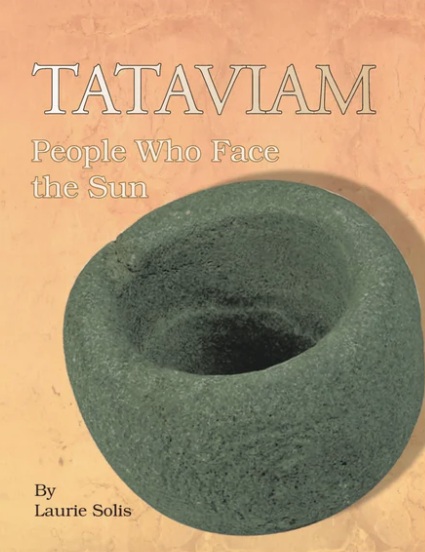
Anthropology professor Dr. Laurie Solis delivered the scholarly presentation on “Tataviam: People Who Face the Sun,” based on her published book of the same title, on Thursday, March 30 at the Santa Clarita Performing Arts Center (PAC).
The prehistoric Tataviam were a Native American group living in the northern San Fernando Valley, Santa Clarita Valley, and southern Antelope Valley, where they actively managed the land through pruning and controlled fires. Professor solis has also served as a liaison to various local tribes, including the Tataviam/Fernandeno Band of Mission Indians.
With the use of photos, maps, and other data from her book, Solis shared her knowledge of the Southern California tribe that she has gained through countless archaeological studies. She also shed light on the Tataviam’s semi-nomadic way of life and plant-based diet, which included yucca and acorns as staples.
Photographs and artifacts relevant to the Tataviam were on view in the PAC lobby prior to the start of Solis’ presentation. Copies of “Tataviam: People Who Face the Sun” were on sale for $20 (cash only). Part of the proceeds benefited the college’s Anthropology Club.
Presenter Biography:
Laurie Solis knew she was going to be an archaeologist when, at the tender age of four, she was overjoyed to find the skeleton of a pet cat buried in her family’s backyard, which she routinely excavated.
Now an adjunct professor of Anthropology at College of the Canyons and Antelope Valley College, Solis has almost 20 years of experience in the field of Cultural Resource Management and specializes in prehistory of the Great Basin and Southwest and Pioneer/Frontier History.
After earning a bachelor’s degree in anthropology from California State University, Northridge (CSUN) in 1997, Solis earned a master’s degree in anthropology from CSUN in 2004.
She has conducted Phase I Archaeological Surveys, Phase II Testing, and Phase III Studies for METRO, High Speed Train Authority, Edwards Air Force Base, Great Basin Unified Air Pollution Control District, California Energy Commission (CEC), Cal Trans, City of Los Angeles Bureau of Engineering, and the County of Los Angeles Department of Parks and Recreation.
She discovered three new species of fish not previously discovered in California, which are held in the collections of the Natural History Museum of Los Angeles County and University of California, Berkeley.
A frequent guest lecturer and public speaker on California Indians, Solis has worked closely as a liaison with several California Indian Tribes, including the Piute-Shoshone, Gabrielino/Tongva, Morongo Band of Mission Indians, the Chumash, the Juaneno, and the Tataviam/Fernandeno Band of Mission Indians.
She has authored almost 200 studies on archaeological, historical and paleontological resources. Her book, “Tataviam: People Who Face the Sun,” is one of the few published works available about the tribe.
Spring 2016
The Brain, Learning and Study Skills
Presented on Thursday, May 21, 2026 at 6pm at the Performing Arts Center by Professors Dr. Edel Alonso

This presentation discussed how the brain works to process information through different stages in storing information as memory, and the study strategies that support and enhance this process. Included in the presentation was information on sensory memory, working memory, long-term memory, metacognition, the structure of the brain and much more. This is a talk that will benefit persons of all ages who want optimum brain and memory capacity. Since the rise of medical imaging technology in the 1990s, the function of the brain during the learning cycle has been studied in earnest by neuroscientists and cognitive and educational psychologists. Working with these innovations has allowed professionals to look at language, memory, learning and problem solving with a new lens — which could lead to many breakthroughs for students struggling to score highly in classes despite long study hours and focused commitment.
Presenter Biography:
More about the presenter
Dr. Edel Alonso has excelled in a variety of fields during her career as an educator. Born in Havana, Cuba, Alonso earned her bachelor’s degree in modern languages at Montclair State University in New Jersey. Following her time on the east coast Alonso went on to earn her master’s degree in counseling from Loyola Marymount University. She then received her doctoral in education from the University of La Verne. At the high school level, Alonso has instructed students in Spanish, French and English as a Second Language, and served as a counselor for many years in the William S. Hart Union High School District as well as inner city Los Angeles. At College of the Canyons, she has served as a counselor to students from the Mathematic Engineering Science Achievement (MESA) program since its inception. She currently serves on the Board of Trustees.
In the classroom, Alonso has also taught graduate students pursuing master’s degrees in counseling at the University of La Verne. Alonso helped develop the curriculum and teach the college’s COUNS 142 “Learning to Learn” course, which also explores how the brain works while teaching strategies designed to optimize the learning process.
Fall 2015
Gala'pagos: A Personal Journey on Darwin's Footsteps
Presented on Thursday, November 19, 2015 at 6pm at the Performing Arts Center by Professors Dr. Miriam Golbert

The presentation, which is based on Golbert’s research in the Galápagos Islands, covered topics ranging from where the islands are located and their unique geological formations, before discussing Charles Darwin’s time spent on the islands, along with his various discoveries and scientific theories. The rich biodiversity and animal life of the Galápagos Islands will also be examined through a collection of Golbert’s personal photographs taken over the course of four trips to the islands. In addition, Golbert hoped to inform attendees about current conservation projects taking place in the region and how they might be able to get involved in the movement to help preserve the islands for generations to come.
Click here to watch: Pompeii Revisited March 11th Scholarly Presentation
Click here to watch: Galapagos Revisited April 15th Scholarly Presentation
Presenter Biography:

Golbert started her education in Argentina, obtaining a Bachelor of Science in biochemistry. She also holds a Master of Science in biology with emphasis in cellular and molecular biology from California State University, Northridge (CSUN) and a Doctorate in Higher Education Leadership from Nova Southeastern University, Florida. Dr. Golbert a current Emeritus faculty member in Biology was involved in a number of activities and initiatives at the college. She worked to create student development workshops on topics including test-taking strategies, and participated in the college’s First Year Experience program designed for incoming freshmen.
Dr. Golbert was previously involved in curriculum development for the biological sciences department, having helped to create courses in the areas of human anatomy, human physiology and concepts of evolution. Golbert also developed the first study-abroad program for the college’s biological sciences department and has traveled with COC students to Costa Rica, Nicaragua, Panama, Argentina, Uruguay, Ecuador and the Galápagos Islands.
Lastly, Golbert served as the faculty advisor for college’s Phi Theta Kappa International Honor Society, Alpha Nu Xi chapter, while working to secure several awards for the chapter at the organization’s Annual International Conferences.
Fall 2014
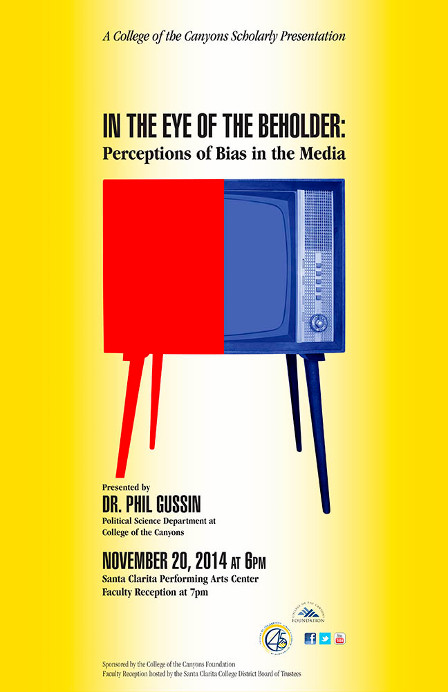
In the Eye of the Beholder: Perceptions of Bias in the Media
Presented on Thursday, Nov. 20, 2014 at 6pm at the Performing Arts Center by Professors Dr. Phil Gussin
About the Presenter
Dr. Phil Gussin is a professor of political science whose research focuses on public opinion, the news media and elections. After working for more than a decade as a plumber and plumbing contractor, Gussin sold his business and returned to college at age 38. He received his master’s degree in political science from California State University, Northridge (CSUN) in 1998, a second master’s degree (2003) and a doctorate in political science from University of California, Los Angeles (UCLA). Utilizing innovative experimental techniques, his dissertation examined the impact that visual images in the news have on citizens’ political preferences. In 2007, Gussin co-authored an article in the Quarterly Journal of Political Science with Dr. Matthew Baum entitled “In the Eye of the Beholder: How Information Shortcuts Shape Individual Perceptions of Bias in the Media.” This article examined the extent to which individuals’ use heuristics – or information shortcuts – to assess the ideological biases of news coverage.
Gussin began teaching at College of the Canyons in 2005. He has also aught at a number of community colleges in the greater Los Angeles area, as well as Pepperdine University and UCLA. In his final year of teaching at UCLA, Gussin was the recipient of the “My Last Lecture” award, which is given to the professor that students find to be the most inspirational. Gussin is the co-advisor for the college’s Political Science Club and the faculty advisor for the award-winning College of the Canyons Model United Nations (COCMUN) team.
Fall 2013
Our Two-Faced(book) World
Presented on Thursday, Nov. 14, 2013 at 6pm at the Performing Arts Center by Professors Katie Coleman
Professor Katie Coleman presented a sociological discussion focused on the wide range of seemingly positive benefits, and corresponding potential for widespread social disintegration, derived from society’s rampant use of popular social networking site. Providing an overview of the history and development of “social media” — from the advent of e-mail to today’s vast networks of virtual communities — Coleman’s presentation began by exploring some of the positive ways in which the use of social networking sites like Facebook, Twitter and Instagram has permeated several longstanding social institutions, while benefitting its users. The presentation explored the theory, shared by some sociologists, that these same social networking sites also contain an inherent dehumanizing agent that can affect its users, and society, in many subtle but very dangerous ways. Coleman went on to point out that society’s widespread use of social networking sites has also contributed to the creation of virtual worlds and online communities in which there are no boundaries, and often no regard for truth or the regulation of behavior.
About the Presenter
Kathryn Coleman is a critical sociologist specializing in the areas of sexuality, deviance, crime, and social control. A College of the Canyons alumna, Coleman received her Master of Arts in Sociology from California State University, Northridge (CSUN), and a Bachelor of Arts in Sociology from University of California, Santa Barbara (UCSB). Her prior sociological research has included published papers on topics including the re-humanization of sexuality, the American prison system and the relationship between academia and intelligence agencies. Coleman began teaching at College of the Canyons in the fall of 2008, covering courses in women’s studies, sexuality, death and dying, criminology and intimate relationships and the family.
Fall 2022
Our Two-Faced(book) World
Presented on Thursday, Nov. 30, 2022 at 6pm at the Performing Arts Center by Dr. Michael Habib & Dr. Sarah Etheridge
Bios
Dr. Michael Habib: Dr. Michael Habib is an Adjunct Associate Professor of Medicine at the University of California Los Angeles, a Research Associate in the Natural History Museum of Los Angeles County, an Adjunct Professor of Biology at College of the Canyons, and a freelance writer/consultant. He is a paleontologist exploring the relationships between animal structure and motion, using a combination of anatomy, art, and engineering. Dr. Habib has authored numerous scientific papers, appeared in a diverse array of television specials, worked as a scientific editor for National Geographic Magazine, writes for Scientific American Magazine, and has applied science to creature design on over 20 projects for leading studios, including BBC, CBC, National Geographic, Creative Differences, YouTube Originals, Amblin Entertainment, and Apple TV+.
Dr. Sarah Etheridge, Chair: Dr Etheridge teaches in Anthropology and gave her Scholarly Presentation on primate conservation in 2012. She became Chair of Scholarly Presentation in 2018. Her research interests are primates, genetics, epidemiology and Egyptology.
Spring 2022: Dr. Sarah Etheridge gave updates on the last 10 years of her research in primate conservation and clean water programs in central America and Africa. You can view the 2012 presentation below.
Presentations:
Vanishing Primates Revisited (2022):
Vanishing Primates (2012) Part 1:
Vanishing Primates (2012) Part 2:
Vanishing Primates (2012) Part 3:
Vanishing Primates (2012) Part 4: