 Resources
 Campus Life
 Just for you


 My Canyons
  Canvas
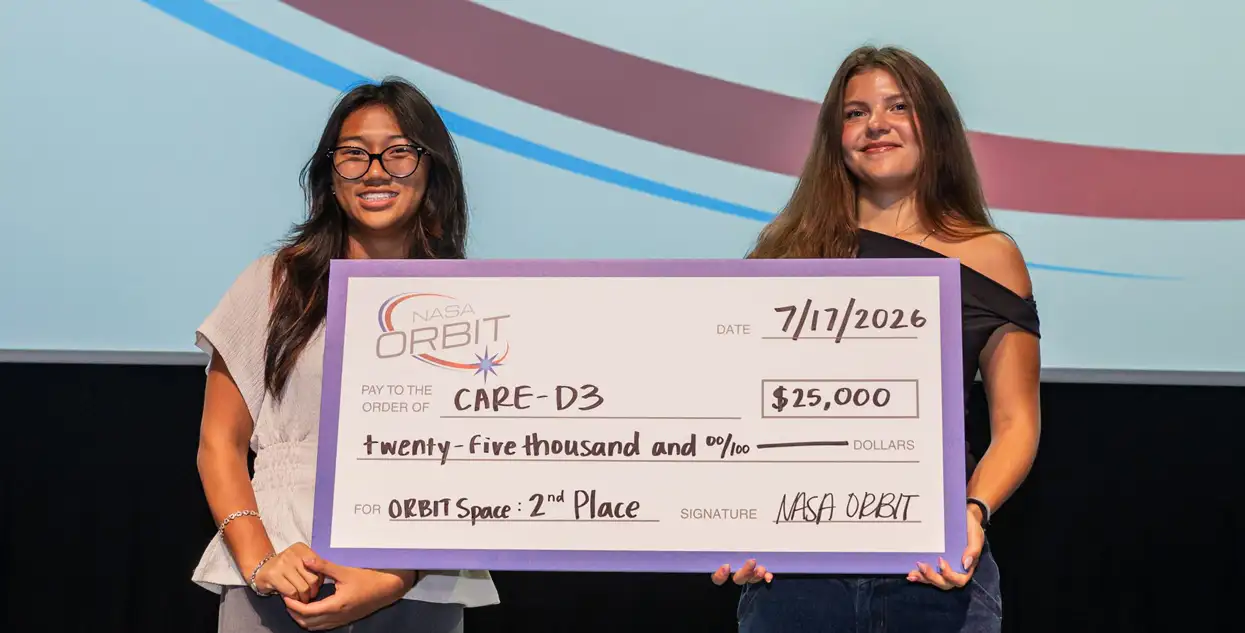
Students Sophia Cranshaw and Tatiana Torrecampo led the CARE-D3 team in the NASA ORBIT Challenge, placing second and winning $25,000.
FOR IMMEDIATE RELEASE
NR-08-12-26-NASAOrbit
August 12, 2026
Student Team Wins Second Place at NASA Orbit Challenge
College of the Canyons student team CARE-D3 earned second place and a $25,000 prize at the 2026 NASA ORBIT Challenge, held in July at Space Center Houston in Texas.
Led by students Sophia Cranshaw and Tatiana Torrecampo, CARE-D3 was the only community college team competing in the challenge's Space Track and one of more than 100 teams from colleges and universities nationwide.
CARE-D3 is a clinical decision-support system designed to help astronauts assess health risks during long-duration space missions where communication delays and limited medical resources can complicate care. The technologies developed for CARE-D3 also have the potential to support healthcare providers in rural, remote, and other resource-limited environments on Earth.
Menoa Yousefi, faculty advisor for the Society of Physics Students (SPS) Club, says he felt proud and excited when he heard the team’s name announced as the second-place winner.
“I had seen firsthand how much time, effort, and passion Sophia and Tatiana put into their project, so watching them earn second place was very rewarding,” said Yousefi. “I was genuinely happy for them because they worked really hard for it, and it was wonderful to see their dedication being recognized on a national stage.”
Cranshaw said her interest in physics began after joining the college's SPS Club, an experience that helped shape her academic and career aspirations.
"Once I began exploring physics for myself, I fell in love with how it could explain the way I have always seen the world," said Cranshaw, who will transfer to UC Davis this fall to study biochemistry and molecular biology. "I hope to contribute to space research that can translate to support patient-centered healthcare as we know it on Earth."
Cranshaw credited COC professors Yousefi, David Michaels, Ryan Kelley, and Kim Berthet for helping build her confidence and encouraging her pursuit of science.
"They challenged me to think beyond the limits I had placed on myself and encouraged me to approach problems with curiosity instead of self-doubt," said Cranshaw. “Each of them showed me that patience, encouragement and a genuine passion for teaching can help students grow far beyond what they think is possible. They believed in me before I fully believed in myself."
As the team's faculty mentor, Yousefi guided the students throughout the competition process while the team developed the concept, conducted research, tested designs and prepared final presentations and poster materials.
According to Yousefi, one of the most valuable outcomes of the competition was the opportunity for students to build professional relationships with peers, NASA representatives and industry leaders.
“Those relationships, along with the invaluable mentorship they will continue to receive as the accelerator program moves forward, will have a lasting impact on their academic and professional growth,” said Yousefi.
The NASA ORBIT Challenge, which stands for Opportunities in Research, Business, Innovation and Technology for the Workforce, is a multi-phase competition that challenges college students to transform NASA technologies and research into innovative solutions with applications both on Earth and in space. Through the program, students gain hands-on experience in research, engineering, entrepreneurship and technology commercialization.
The competition's final phase was held at Space Center Houston, the official visitor center for NASA's Johnson Space Center. Finalist teams presented research posters, delivered live pitches and participated in question-and-answer sessions before a panel of judges, while also attending presentations from NASA and industry professionals.